Conversation with
Charles Lang & Lucius Von Joo
Digital Futures Institute, Teachers College, Columbia University
OPEN CLASSROOM - CLOSED DOORS: The Generational Cost of All-in
LVJ: We're sitting here, in the Teachers College, Columbia University, the Digital Futures Institute gallery, and right now you're seeing a little piece of an exhibit called The Dead Tech Exhibit. I'm Lucius Von Joo. I'm the associate director of design education here at DFI.
CL: My name is Charles Lang. I'm the, executive director of the Digital Futures Institute.
LVJ: Open schools, which is an idea that is right behind us. And we're really playing within this conversation. Didn't really have one person.
CL: For open schools, it really seems like it was a moment where a bunch of things came together. The politics worked. There were a bunch of people willing to fund, the building of new schools. The mood among educators was right to start this movement, to break down the walls within classrooms.
LVJ: So actually, even being here at Teachers College, there were laboratory schools, with the Dewey movement, about playing with space and about how should we change the dynamics of space. So, students and children in his case, can interact differently. And so with open schools, it actually, was an idea that traveled to the UK, was very popularized there and then actually came back to the US. And this is again, like the 60s and 70s, there's a whole large generation of young, learners in schools. They need new spaces, older buildings are actually becoming kind of that era where they're falling apart from when school first became mandatory in the US in the early aughts. And so you have that kind of everything happening at once. But this wasn't a new idea.
So obviously, like the open school method to full disclosure, sometimes it's called open classrooms, sometimes it's called, open school design. So it's really flexible on the terms. Some sometimes those are more theoretical, sometimes they're more, really practical based. But we're basically talking about a movement that definitely redesigned the shape of schools.
And again, the idea is not new. You had the Sahn’s schools of the past, where you had courtyards. That and this is very the distance past we had courtyards where people could visit different learning situations. So this idea of the open space you had. Peripatetic schools that, you know, you had the teacher walking and the group following them through courtyards. So and then later, even more recent, you had the single, single room schoolhouse that wasn't maybe by choice. That was by necessity of space. But you had a shared space.
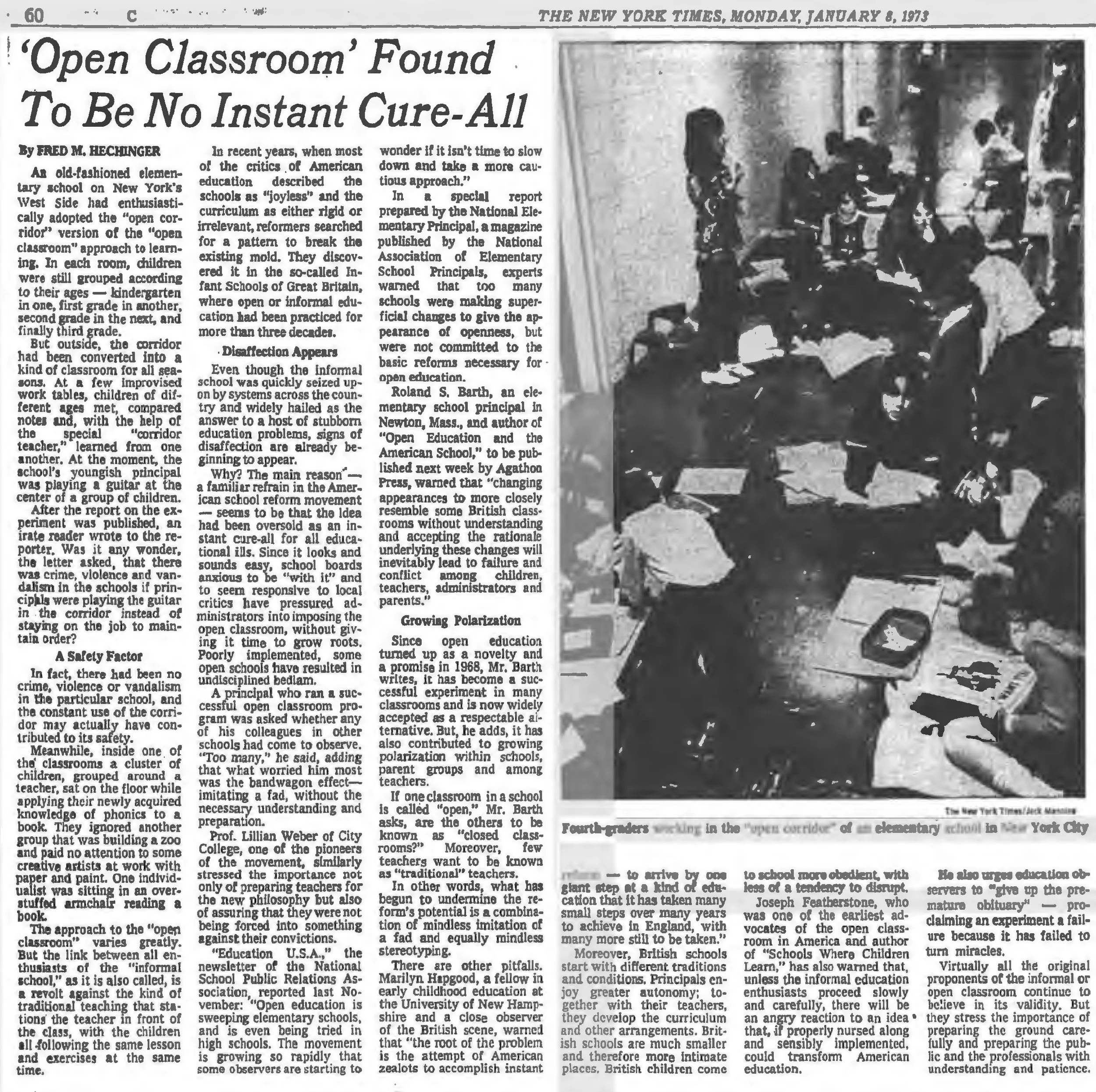
And I think the big part of the open school movement was this idea for democracy, for collaboration, for shared resources. So obviously, by taking away the walls, you start creating those situations. But with that it created friction. So, the biggest one being acoustics in the space. That was a major issue. Even in the video that's playing behind us when they're talking about it, anytime they're showing the classroom, you can hear the video. They just turned down the audio to show it, to show this kind of like picture perfect flow. And so you had teachers, building barricades to try to create these kind of acoustic barriers between them in another space.
“…the big part of the open school movement was this idea for democracy, for collaboration, for shared resources.”
Open Classroom
CL: So there's this idea that people go all in on these revolutionary ideas that are going to change everything. That's the sales pitch. So it's like everything else is kind of irrelevant other than this one idea. And when you do that, when you go all in and it doesn't quite work out, which is what happens a lot of the time.
What we're interested in thinking about is whether that then prevents future dreaming.
So what were the knock on effects of of people going so all in on, removing walls in schools, and reinventing school in that way.
Has that meant that future future designers and future people have been unable to raise the same amount of, political and economic capital to do other design ideas?
So did it hamper future dreaming of the ways that schools could be designed?
LVJ: And even when we look around this exhibit, there's all these different technologies. But obviously the structures of the school is a major investment.
And so when we invest to that level, we we don't have often the currency or, needs to do all the training afterwards.
So many of these schools were built and then there was no money put aside for training teachers for how to use these spaces. So you had, again, these open spaces, but no training on how to use them. So you often see again, really, kind of makeshift barriers. But again, it took decades and decades to be even have the funds in a place that you could change it or reimagine it again.
And I think you know, Charles is talking about is it really is that risk of what is the cost?
And again, something that we think through here, where are the promises that are made with that new technology?
CL: I mean, I education is like, I don't want, we don't want to make it seem like this is easy. These are really hard problems. And part of the difficulty in education is the time scale. So when we educated, a child in a classroom we're kind of expecting or the state is expecting that that will bear fruit 20 or 30 years later. And that timescale is really weird for people to think about it. I think it's really hard to think about, well, okay, if I'm designing a classroom for little kids, and, that that effect is supposed to occur over such a long timescale.
What does that mean for my design? That's a very hard problem.
At the same time, the buildings stick around for a long time. You know, you have some schools around for 100, 100 plus years. So the kind of scale I think is hard to work with.
And I don't think any of these ideas that we've kind of presented in Dead Tech really were able to grapple with the time scale that, that they were working with.
Everything was very like, it needs to happen now, now, now. And we're going to see results immediately. And this kind of sales pitch type thing, which is, is kind of divorced from the reality of how these things then play out.
“…part of the difficulty in education is the time scale. So when we educated, a child in a classroom we're kind of expecting or the state is expecting that that will bear fruit 20 or 30 years later…”
1960 s Modernist Architecture criticized by schoolgirls
LVJ: With school design, this is what it comes down to. We start considering you know, if we have this opportunity to dream, which we don't want to stop this. We it's wonderful to keep creating. And if we do get in a space again, for example, right now we're really focused on personalized education and what that means for learning and what that means for design. I think it's important as we design to imagine the promises that we're making with it, and imagine if those promises are for the immediate and for funding, or if these promises are for an imagined change for generations and how they'll fit and how somebody else might take it a different way.
And so I think even when you're sitting in the space you currently are, just look around, especially if you're in a school or school adjacent.
What were those promises made that created that space?
And so I think that's important to think about and kind of with your dreaming, just whatever that design, if you were to look around and redo it, what promises are you making?
Who are you promising those for, who has access to those promises, and who's going to carry those out and continue to make those promises happen instead of just what we play with?
Again, where you have these moments of disillusionment, where it just didn't happen as it was meant to be.
And so it's that kind of cost. So I think we just kind of want to close with the idea of looking around your space, imagining how you would change it, and then just weighing your promises with that.
“…it's important as we design to imagine the promises that we're making with it…”
Charles Lang is the Senior Executive Director at Teachers College, Columbia University
Lucius Von Joo is the Associate Director of Design Education at Teachers College, Columbia University